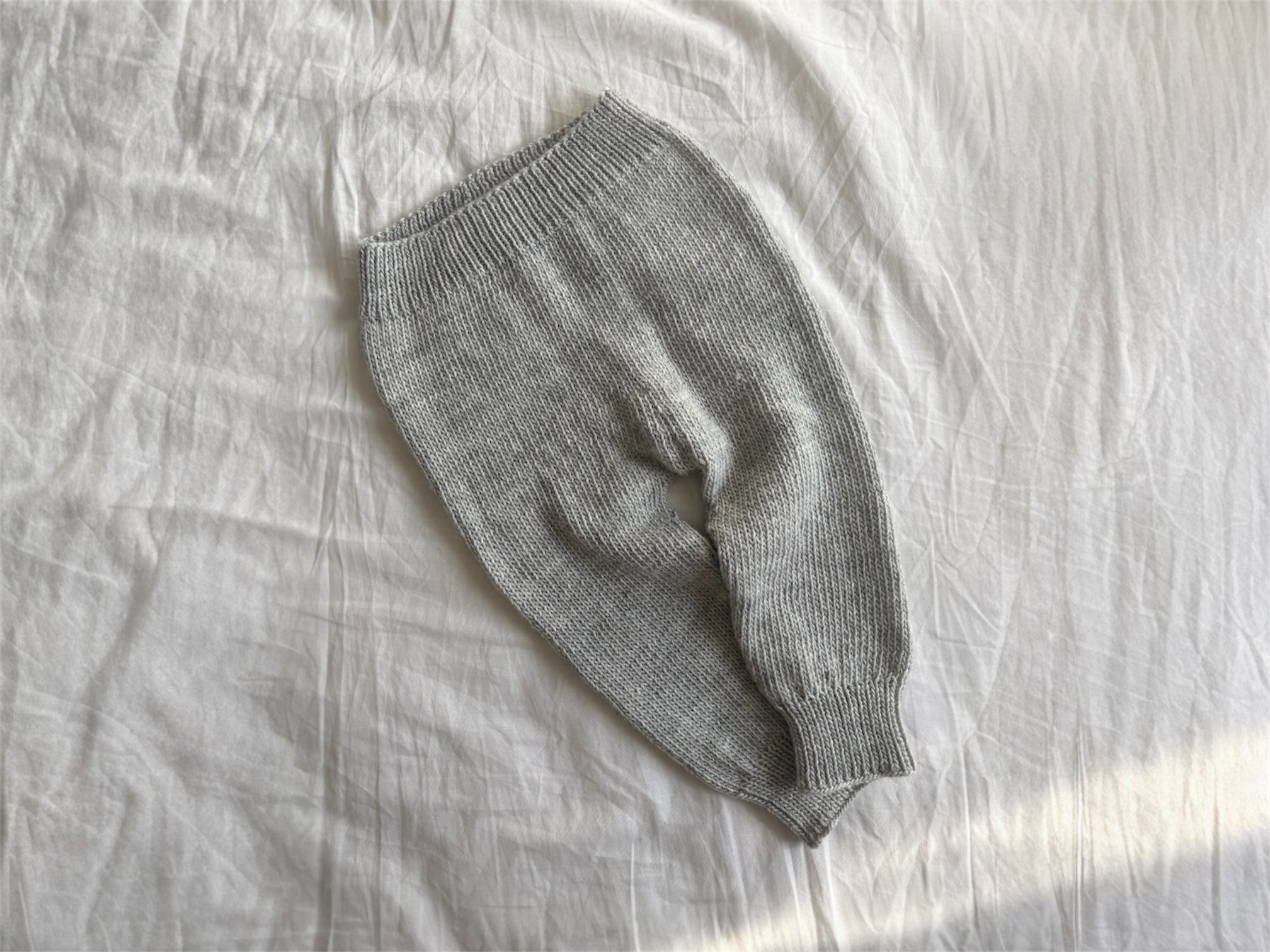
| Size: | 1–3 months (hip circumference: 47 cm ) |
| Measurements: | Pants width: 24 cm Pants length (measured at the front): 37 cm Leg length (measured along the inside of the led): 19 cm |
| Gauge: | 27 sts x 37 rows in stockinette stitch on 3.5 mm needles = 10 x 10 cm |
| Needles: | Circular needles: 3.5 mm / 40 and 60 cm and 3 mm / 40 and 60 cm; Double-pointed needles: 3.5 mm, 3.0 mm |
| Materials: | 100 g Drops Baby Merino (50 g / 175 m) or a similar yarn, provided the correct gauge is obtained. |
The March Pants are worked from the top down in stockinette stitch. The back is shaped using German Short Rows for a better fit. A gusset is then worked before the work is divided for the legs. The legs are worked in the round on double-pointed needles or using the Magic Loop technique.
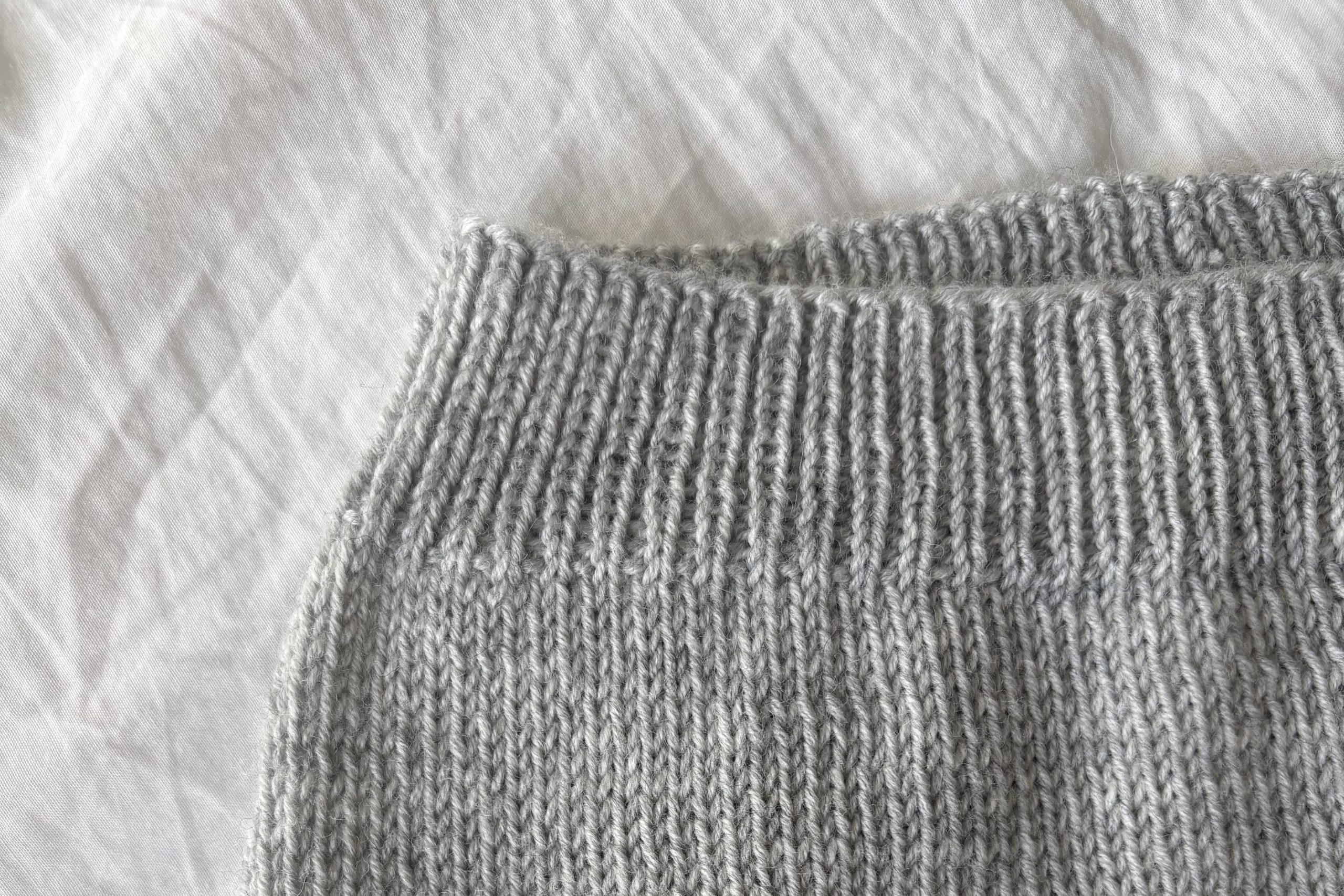
Waistband
Cast on 132 + 1 sts on 3.0 mm circular needles using your preferred cast-on method (e.g. long-tail cast-on). Join to work in the round, using the extra stitch if desired to close the gap. There are 132 sts on the needles.
Place a marker for the beginning of round (BOR).
Work 4 cm in 1×1 rib (k1, p1).
Body
Change to 3.5 mm needles.
Now lengthen the back of the pants using short rows. Use the German Short Rows technique for the turns as follows:
| Row 1 (RS): | knit 8, turn |
| Row 2 (WS): | make a double stitch, p7, slip BOR marker, p8, turn |
| Row 3 (RS): | make a double stitch, k7, slip BOR marker, k7, knit the double stitch, k8, turn |
| Row 4 (WS): | make a double stitch, p15, slip BOR marker, p7, purl the double stitch, p8, turn |
| Row 5 (RS): | make a double stitch, k15, slip BOR marker, k15, knit the double stitch, k8, turn |
| Row 6 (WS): | make a double stitch, p23, slip BOR marker, p15, purl the double stitch, p8, turn |
| Row 7 (RS): | make a double stitch, k23, slip BOR marker, k23, knit the double stitch, k8, turn |
| Row 8 (WS): | make a double stitch, p31, slip BOR marker, p23, purl the double stitch, p8, turn |
| Row 9 (RS): | make a double stitch, k31 |
| Round 10: | k31, knit the double stitch, knit to the next double stitch, knit the double stitch, knit to BOR |
The short rows are now complete. Continue working in the round.
Work 9 cm in stockinette stitch in the round.
After working the body, begin working the gusset.
Gusset
| Round 1: | [k 1, M1R, k 64, M1L, k 1]x2 – 136 sts |
| Rounds 2-6: | knit 136 sts |
| Round 7: | [k 2, M1R, k 64, M1L, k 2]x2 – 140 sts |
| Rounds 8-12: | knit 140 sts |
| Round 13: | [k 3, M1R, k 64, M1L, k 3]x2 – 144 sts |
| Rounds 14-18: | knit 144 sts |
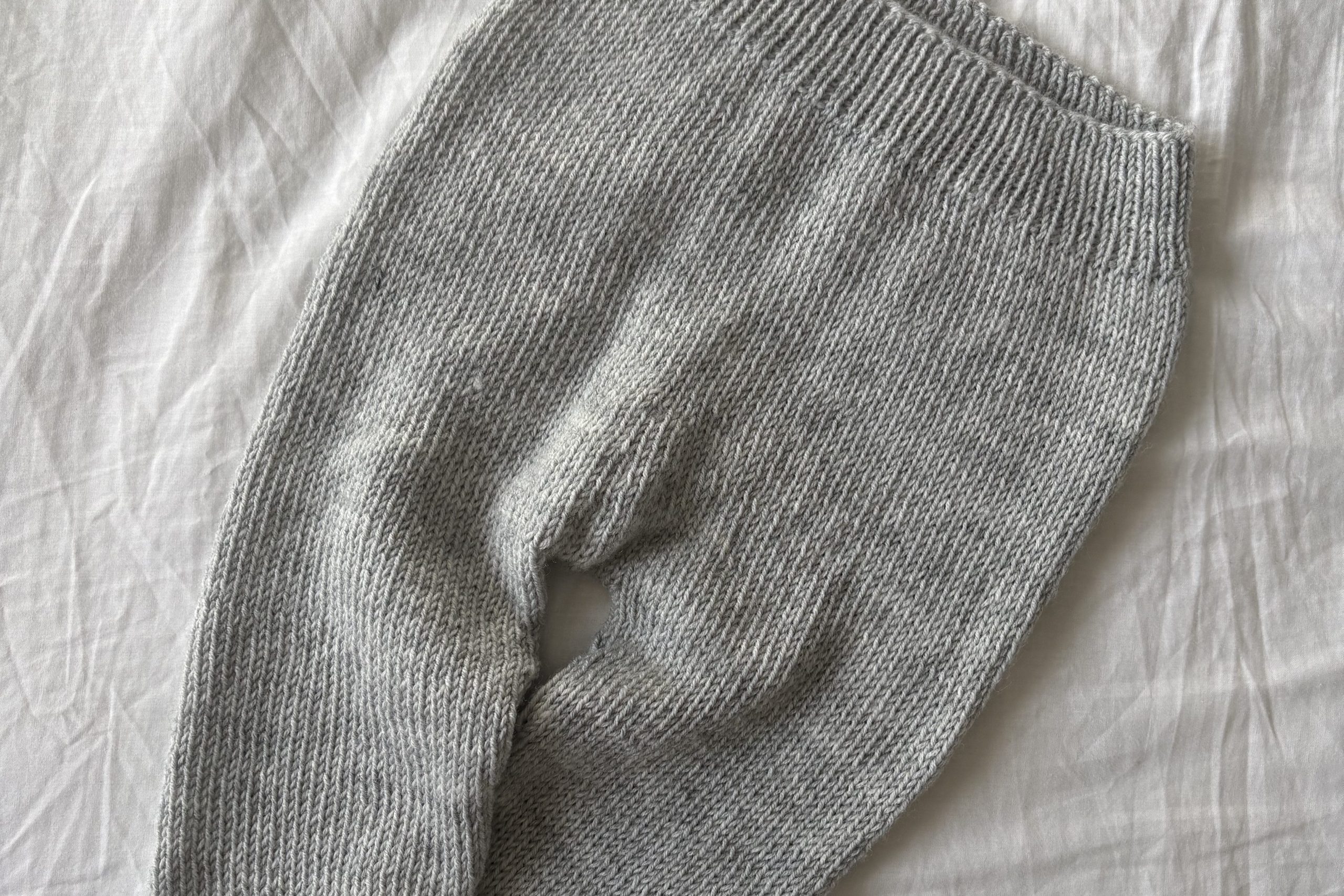
Work the gusset as follows:
The gusset is now complete. Divide the work for the legs.
Divide for Legs
The beginning of round (BOR) is located at the center of the back gusset.
Knit 4 sts (back gusset), knit the next 64 sts — first leg, place the next 8 sts (front gusset), 64 sts (second leg), 4 sts (back gusset) and he first 4 sts worked at the beginning of the round on a stitch holder or scrap yarn.
The 16 gusset stitches and the 64 stitches of the second leg (80 sts total) are now on hold.
Continue working the legs one at a time.
Leg
There are 64 sts on the needles.
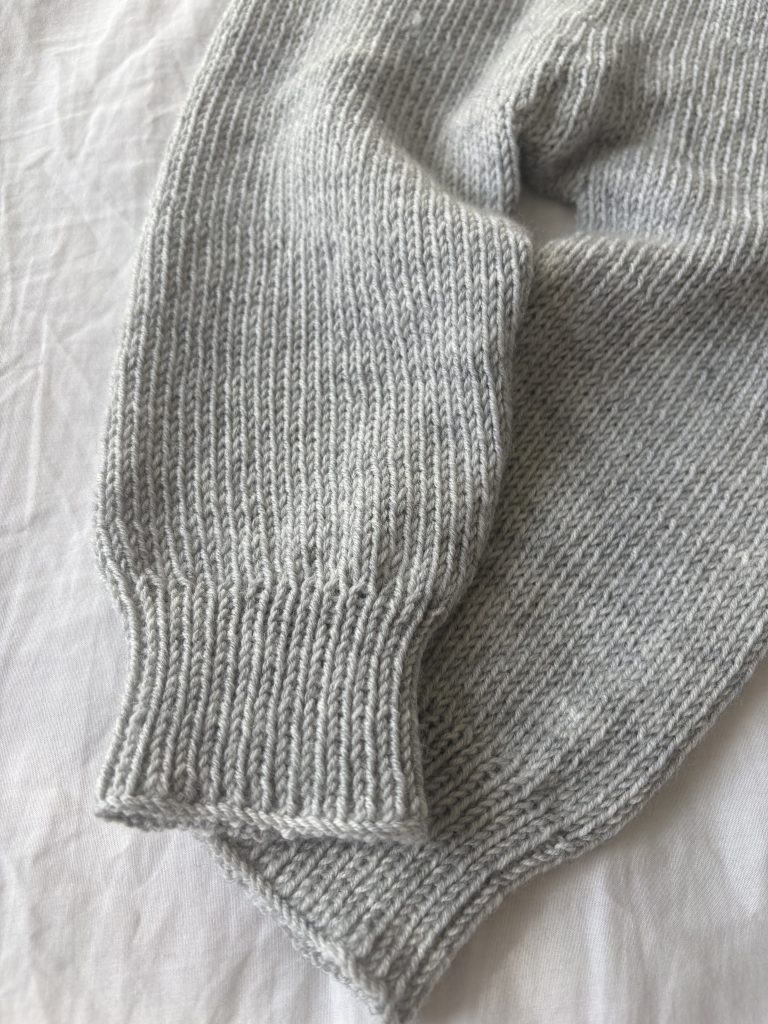
Work in the round in stockinette stitch until the leg measures 14 cm, measured along the inside of the leg, while at the same time working decreases every 10th round a total of 5 times as follows:
k2tog, knit to the last 2 sts of the round, ssk.
There are now 54 sts on the needles.
Change to 3.0 mm needles and work 5 cm in 1×1 rib (k1, p1).
Bind off using your preferred bind-off method.
Second Leg
Return to the held stitches.
Place the first 8 gusset stitches on a stitch holder or scrap yarn, transfer the next 64 sts to 3.5 mm needles, then place the remaining 8 gusset stitches on another stitch holder or scrap yarn.
Join the yarn, leaving a 20–25 cm tail.
Knit the second leg in the same way as the first.
Finishing the Gusset
Transfer the 16 held gusset stitches to the needles.
Using the 20–25 cm yarn tail left earlier, graft the stitches together using Kitchener stitch.
Secure the yarn and weave in the end.
Abbreviations
| k | knit |
| p | purl |
| stockinette | stockinette stitches are made when you knit on the right side and purl on the wrong side |
| k2tog | knit 2 stitches together (right-leaning decrease); |
| ssk | slip, slip, knit (left-leaning decrease); |
| M1L | make 1 left (increase leaning to the left); |
| M1R | make 1 right (increase leaning to the right); |
| st(s) | stitch(es) |
| RS | right side |
| WS | wrong side |
Like this pattern?
Consider buying me a coffee
Leave a Reply