Category: Knitting patterns

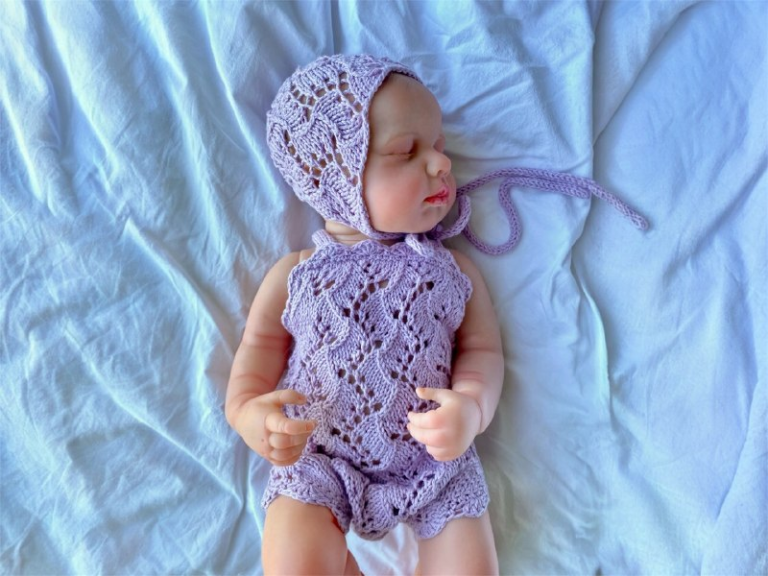
  • “Lines” Baby Bonnet Knitting Pattern (1–3 Months, Beginner-Friendly)

    “Lines” Baby Bonnet Knitting Pattern (1–3 Months, Beginner-Friendly)

    Finished size:Fits approximately 1–3 months
    Needles:3.0 mm and 3.5 mm (US 2.5 and US 4)
    Yarn:Suitable baby yarn (DK / light worsted)

    Notions: Stitch markers, stitch holder or scrap yarn, tapestry needle

    Cast on 66 sts on 3.0 mm needles using your preferred method (I use long-tail cast on).

    Rows 1–3:Edge stitch, knit to end.

    Change to 3.5 mm needles. Work in garter stitch (knit every row) until piece measures 12 cm from cast-on edge.

    Divide sts into three equal sections of 20 sts each and place markers between sections.

    Short Row Shaping (Back of Head)

    Work short rows on center and side sections to shape the back of the head. Always begin with the edge stitch.

    Row 1 (RS):Edge st, knit 20 (side), knit 21 (center), ssk 1 st from center and 1 st from side. Turn
    Row 2 (WS):Edge st, knit 20, k2tog 1 st from center and 1 st from side. Turn.
    Row 3:Edge st, k2tog, knit 16, ssk 1 central and 1 side st. Turn.
    Row 4: Edge st, knit 18, k2tog 1 central and 1 side st. Turn.
    Row 5:Edge st, knit 18, ssk 1 central and 1 side st. Turn.
    Row 6:Edge st, knit 18, k2tog 1 central and 1 side st. Turn.
    Row 7:Edge st, k2tog, knit 14, ssk 1 central and 1 side st. Turn.
    Row 8:Edge st, knit 16, k2tog 1 central and 1 side st. Turn.
    Row 9:Edge st, knit 16, ssk 1 central and 1 side st. Turn.
    Row 10:Edge st, knit 16, k2tog 1 central and 1 side st. Turn.
    Row 11:Edge st, k2tog, knit 12, ssk 1 central and 1 side st. Turn.
    Row 12:Edge st, knit 14, k2tog 1 central and 1 side st. Turn.
    Row 13:Edge st, knit 14, ssk 1 central and 1 side st. Turn.
    Row 14: Edge st, knit 14, k2tog 1 central and 1 side st. Turn.
    Row 15:Edge st, k2tog, knit 10, ssk 1 central and 1 side st. Turn.
    Row 16:Edge st, knit 12, k2tog 1 central and 1 side st. Turn.
    Row 17:Edge st, knit 12, ssk 1 central and 1 side st. Turn.
    Row 18:Edge st, knit 12, k2tog 1 central and 1 side st. Turn.
    Row 19: Edge st, k2tog, knit 10, ssk 1 central and 1 side st. Turn.
    Row 20:Edge st, knit 10, k2tog 1 central and 1 side st. Turn.
    Row 21:Edge st, knit 10, ssk 1 central and 1 side st. Turn.
    Row 22:Edge st, knit 10, k2tog 1 central and 1 side st. Turn.
    Row 23:Edge st, k2tog, knit 6, ssk 1 central and 1 side st. Turn.
    Row 24:Edge st, knit 8, k2tog 1 central and 1 side st. Turn.
    Row 25: Edge st, knit 8, ssk 1 central and 1 side st. Turn.
    Row 26:Edge st, knit 8, k2tog 1 central and 1 side st. Turn.
    Row 27:Edge st, k2tog, knit 4, ssk 1 central and 1 side st. Turn.
    Row 28:Edge st, knit 6, k2tog 1 central and 1 side st. Turn.
    Row 29:Edge st, knit 6, ssk 1 central and 1 side st. Turn.
    Row 30:Edge st, knit 6, k2tog 1 central and 1 side st. Turn.
    Row 31:Edge st, k2tog, knit 2, ssk 1 central and 1 side st. Turn.
    Row 32:Edge st, knit 4, k2tog 1 central and 1 side st. Turn.
    Row 33:Edge st, knit 4, ssk 1 central and 1 side st. Turn.
    Row 34:Edge st, knit 4, k2tog 1 central and 1 side st. Turn.
    Row 35:Edge st, k2tog, ssk 1 central and 1 side st. Turn.
    Row 36:Edge st, knit 2, k2tog 1 central and 1 side st. Turn.
    Row 37:Edge st, knit 2, ssk 1 central and 1 side st. Turn.
    Row 38:Edge st, knit 2, k2tog 1 central and 1 side st. Turn.
    Row 39:Edge st, ssk 1 central and 1 side st. Turn.
    Row 40:Edge st, knit 2, k2tog 1 central and 1 side st. Turn.
    Row 41:Edge st, knit 2, ssk 1 central and 1 side st. Turn.
    Row 42:Edge st, knit 2, k2tog 1 central and 1 side st. Turn.
    Row 43:Edge st, knit 2, ssk 1 central and 1 side st. Turn.
    Row 44:Edge st, knit 2, k2tog 1 central and 1 side st.

    Place 4 sts on a holder or scrap yarn. Break yarn.

    Hat shaping complete.

    Ties

    Cast on 4 sts on 3.5 mm needles using your preferred method. Slide sts to right edge of the needle.

    Work I-cord: knit all stitches, slide sts to right edge, continue until I-cord measures 20–25 cm (8–10 in).

    Attach tie to bonnet securely.

    * Pick up 1 stitch. Slide the stitches to the right edge of the needle. Knit 3, ssk. *

    Repeat from * to * to the end of the row. Now knit i-cord 20 to 25 cm long.

    Finishing

    Weave in all ends. Block gently to shape.

    Your «Lines» Baby Bonnet is now complete!

    Abbreviations

    kknit
    ppurl
    st(s)stitch(es)
    RSright side
    WSwrong side
    slslip
    sskslip, slip, knit
    k2togknit two together
    edge stitchslip the first stitch

    Like this pattern?

    Consider buying me a coffee

  • Little Teddy Bear (flat vers.) Knitting Pattern

    Little Teddy Bear (flat vers.) Knitting Pattern

    Size:the height of the toy may vary depending on the yarn used and the number of knitting needles
    Needles:straight needles 3.5 mm (long enough to hold all stitches comfortably) or circular needles 3.5 mm with a long cable for flat knitting or use knitting needles 1-1.5 sizes smaller than recommended for yarn
    Materials:30 g yarn Drops Soft Tweed (50g/130m), black embroidery thread for eyes and nose or another yarn

    For example: 50g/130m Drops Soft Tweed on 3.50 mm needles produces a toy 17 cm high

    The Little Teddy Bear is knitted flat in rows from the top down, in one piece from head to legs. The hands, nose and ears are worked separately and sewn on. Finishing includes seaming all parts with mattress stitch (or whipstitch where specified).

    Cast on 32 stitches using your preferred cast-on method (I use the long-tail cast-on). The knitting begins with a wrong side (WS) row on the WS.

    Row 1 (WS):purl 32 sts The first and last stitches are worked according to the pattern – this applies to all rows throughout the project.
    Row 2 (RS):k 5, M1L, k 8, M1L, k 7, M1L, k 8, M1L, k 4 – 36 sts
    Rows 3‑19:36 sts in stockinette
    Row 20 (RS):k 5, M1L, k 9, M1L, k 8, M1L, k 9, M1L, k 5 – 40 sts
    Rows 21‑23:40 sts in stockinette
    Row 24 (RS):k 5, M1L, k 10, M1L, k 9, M1L, k 10, M1L, k 6 – 44 sts
    Row 25 (WS):purl 44 sts
    Row 26 (RS):k 44 sts Mark the 11th and 12th stitches, and the 32th and 33th stitches.
    Row 27 (WS):purl 44 sts
    Row 28 (RS):k 11, M1L, k 10, M1R, k 2, M1L, k 10, M1L, k 11- 48 sts
    Rows 29-31:48 sts in stockinette
    Row 32 (RS):k 23, M1R, k 2, M1L, k 23 – 50 sts
    Rows 33-35:50 sts in stockinette
    Row 36 (RS):k 24, M1R, k 2, M1L, k 24 – 52 sts
    Row 37 (WS):purl 52 sts
    Row 38 (RS):k 25, M1R, k 2, M1L, k 25 – 54 sts
    Rows 39‑43:54 sts in stockinette
    Row 44 (RS):k 4, ssk, k 12, k2tog, k 14, ssk, k 12, k2tog, k 4 – 50 sts
    Rows 45‑47:50 sts in stockinette
    Row 48 (RS):k 18, [ ssk, k 2 ] x 2, k2tog, k 2, k2tog, k 18 – 46 sts
    Row 49 (WS):purl 46 sts
    Row 50 (RS):k 17, [ ssk] x 3, [ k2tog ]x 3, k 17 – 40 sts
    Row 51 (WS):purl 40 sts
    Row 52 (WS):bind off 4 stitches, k 13 stitches, bind off 6 stitches, k 13 stitches, bind off 4 stitches

    Cut the yarn, leaving a 30-35 cm tail. Next, continue with the legs.

    Place the remaining 13 stitches on a holder, scrap yarn, or another needle. Join a new yarn. Start knitting from the right side.

    Rows 1-10:13 sts in stockinette
    Row 11 (RS):k 1, [ ssk, k 1] x 4 – 9 sts
    Row 12 (WS):purl 9 sts                                                                                      

    Break the yarn, leaving a 10–15 cm tail. Thread the yarn through the remaining 9 stitches, pull tight to close, secure, and weave in the end.
    Repeat the process for the second leg.

    Join a new yarn and work the second leg the same way as the first, starting from row 1. Break the yarn, leaving a 30-35 cm tail. Transfer 9 stitches onto the yarn using a yarn needle and pull tight.

    Sewing along the back

    Weave in the short tails inside the toy; leave the long tails for further seaming. You should be left with 2 working yarn tails.
    Sew the body along the back using mattress stitch.

    Seaming the bottom

    Now move on to seaming the bottom. Seam from one leg to the other.

    Sew the leg with mattress stitch, sew the center section (between the legs) using whipstitch, then sew the second leg with mattress stitch.

    Stuff the bear and move on to sewing the upper part with a new yarn.

    Sewing the upper part

    Find 2 central stitches along which increases were made. Mark the middle.

    Count 7 stitches to the right and insert the needle into the seventh stitch. On the other side: Skip 1 stitch, and insert the needle into the next stitch.
 (Watch here this moment.)


    Sew the upper section using whipstitch.

    Leave in tails inside the toy.

    Hands

    Cast on 6 stitches using your preferred cast-on method, leaving a 25-30 cm tail (this will be used later to sew the hand). I use long tail cast-on method. The knitting begins with a wrong side (WS) row on the WS.

    Row 1 (WS):purl 6 sts
    Row 2 (RS):k 1, [ k 1, M1L ] x 4, k 1-10 sts                                                   
    Rows 3‑21:10 sts in stockinette

    Transfer any 5 stitches to a separate needle. Fold the hand in half and k together the stitches from both needles and bind off.

    Pull the lower end of the yarn through 6 stitches. Sew the hand using mattress stitch. Stuff the hand as sewing.

    Knit the second hand the same way.
    Sew the hands to the marked stitches using whipstitch.

    Ears

    Cast on 8 stitches using your preferred cast-on method, leaving a yarn tail of about 15–20 cm. I use long tail cast-on method. The knitting begins with a wrong side (WS) row on the WS.

    Rows 110:8 sts in stockinette                                                                      

    You should get a square shape (adjust the number of rows if necessary).
    Break the yarn, leaving a 15–20 cm tail. Thread the yarn through the 8 stitches, pull tight, and secure.

    Pull the yarn tail from the cast-on edge through the 8
    stitches, pull tight, and secure.

    Then tie the two yarn tails together — this will form a semicircle.
    Knit the second ear the same way.Sew them on using any method you prefer.

    Nose

    Cast on 20 stitches using your preferred cast-on method (I use the long-tail cast-on). The knitting begins with a wrong side (WS) row on the WS.

    Row 6 (RS):k 1, [ k 1, k2tog, k2tog, k 1 ] x 3, k 1 – 14 sts                     
    Row 7 (WS):p 1, [ p2tog ] x 6, p 1 – 8 sts

    Break the yarn, leaving a 20-25 cm tail. Pull the yarn through 8 stitches.
    Sew the nose using mattress stitch.
    Stuff the nose and sew to the head using whipstitch.
    Embroider the nose and eyes with black thread.


    Abbreviations

    kknit
    ppurl
    stockinettestockinette stitches are made when you knit on the right side and purl on the wrong side
    k2togknit 2 together (right-leaning decrease);
    sskslip, slip, knit (left-leaning decrease);
    p2togpurl 2 together (right-leaning decrease);
    sspslip, slip, purl (left-leaning decrease);
    M1Lmake 1 left (increase leaning to the left);
    M1Rmake 1 right (increase leaning to the right);
    st(s)stitch(es)
    RSright side
    WSwrong side
    edge stslip the first stitch of the row purlwise with yarn in front

    Like this pattern?

    Consider buying me a coffee

  • Teddy Bear Sweater Knitting Pattern

    Teddy Bear Sweater Knitting Pattern

    Materials

    • Knitting needles of appropriate size

    • Yarn suitable for teddy-bear clothing

    • Stitch holders or scrap yarn

    • Stitch markers

    Body

    Cast on 46 + 1 stitch using your preferred cast‑on method.

    Join to work in the round.

    Rounds 1‑6:[k1, p1] × 23 – 46 sts
    Round 7:(k2, M1L) × 23 – 69 sts                                                          
    Rounds 812:knit all 69 sts

    Round 13: knit 4 sts, place next 8 sts on stitch holder (sleeve), cast on 2 new sts, knit 26 sts (front), place next 8 sts on stitch holder (sleeve), cast on 2 new sts, knit 24 sts (back)

    Rounds 1424:Knit all 57 sts
    Round 25:ssk, p1, [k1, p1] × 27 – 56 sts                                           
    Rounds 2627:[k1, p1] × 28 – 56 sts

    Bind off 56 sts.

    Sleeves (make 2)

    Return 8 held sts to the needles.

    Pick up and knit 6 sts at the underarm (14 sts total).

    Place marker for beginning of round.

    Rounds 210:knit all 14 sts.
    Rounds 1113:[k1, p1] × 7 – 14 sts                                                                   

    Bind off all sts.

    Close small holes at underarm while weaving in ends.

    Like this pattern?

    Consider buying me a coffee

  • Cozy Autumn Mushrooms – Knitting Pattern

    Cozy Autumn Mushrooms – Knitting Pattern

    Autumn is the perfect time for cozy projects, and these little knitted mushrooms make a charming decoration or gift. Even beginners can follow this pattern, as it’s worked in simple rounds with easy increases and decreases.

    Needles & Materials

    Before you start, gather your supplies:

    • Needles: 2.5–3 mm

    • Yarn: leftover yarn in two colors

    • Gauge: not essential

    • Construction: knit in the round using Magic Loop

    • Difficulty: Beginner-friendly

    Abbreviations

    Here are the abbreviations used in this pattern:

    kknit
    ppurl
    k2togknit 2 stitches together                                                                       
    M1Lmake 1 left increase
    stsstitches

    Stem

    We’ll start with the stem, which is a simple cylinder shape.

    Step 1:Cast on 5 sts using any cast-on method. Join to work in the round.
    Round 1:k5
    Round 2:(k1, M1L) ×5 – 10 sts
    Round 3–17:k10
    Finishing the stem:Break yarn, pull tail through 5 remaining sts, tighten and weave in.

    Stuff the stem lightly.

    Cap Increases

    Now we’ll start the cap, beginning with gradual increases to give it a rounded shape. Attach the cap color.

    Attach cap color.

    Round 18: (k1, M1L) ×10 – 20 sts
    Round 19: k20
    Round 20:(k2, M1L) ×10 – 30 sts                                                                   
    Round 21:k30
    Round 22:k30
    Round 23:p30

    These rounds form the wide, round shape of the mushroom cap.

    Cap Body

    Maintain the width of the cap for a few rounds:

    Round 24–26:k30                                                                                                 

    This gives the cap a full, natural look before we begin decreasing.

    Cap Decreases

    To finish the cap, we’ll decrease stitches gradually to create a smooth top.

    Round 27: (k2tog, k3) ×6 – 24 sts
    Round 28:k24
    Round 29:(k1, k2tog, k1) ×6 – 18 sts                                                            
    Round 30: k18
    Round 31:(k2tog, k1) ×6 – 12 sts
    Round 32: (k2tog) ×6 – 6 sts

    Break yarn, thread tail through 6 sts, tighten to close, weave in.

    Stuff before closing

    Your cozy autumn mushroom is now complete! You can make several in different colors and sizes to create a charming fall display. These mushrooms also make adorable handmade gifts or seasonal decorations.

    Like this pattern?

    Consider buying me a coffee

  • Little Teddy Bear (in-the-round vers.) Knitting Pattern

    Little Teddy Bear (in-the-round vers.) Knitting Pattern

    Size: the height of the toy may vary depending on the yarn used and the number of knitting needles

    Needles: use knitting needles 1-1.5 sizes smaller than recommended for yarn

    Materials: 50 g yarn

    For example

    Drops Soft Tweed 50% Wool, 25% Alpaca, 25% Viscose 50g/130 m on 3.5 mm needles produces a toy 18 cm high.

    Pattern + Video

    Hands (Paws ? 😀)
    Cast on 4 sts on needles with your preferred cast-on method. I use long tail cast-on method. Join your work in the round.

    Round 1:knit 4 sts
    Round 2:[ k 1, M1R ] x 4
    Round 3‑20:knit 8 sts

    Pull the lower end of the yarn through 4 stitches, pull and fasten the yarn, hide inside hand.
    Break the yarn, place the 8 sts on stitch holder or length of leftover yarn.
    Stuff the hand a little.
    Knit the second hand similarly to the first.

    Legs

    Left leg
    Cast on 6 sts on needles with your preferred cast-on method. I use long tail cast-on method. Join your work in the round.

    Round 1:knit 6 sts
    Round 2:[ k 1, M1R ] x 6
    Round 3‑9:knit 12 sts

    Pull the lower end of the yarn through 6 stitches, pull and fasten the yarn, hide inside leg.
    Break the yarn 20 cm, place the 12 sts on stitch holder or length of leftover yarn.

    Right leg
    Knit the right leg similarly to the left, but don’t break the yarn.
    Let’s move on to knitting the body.

    Body

    Round 1:knit 6 sts right leg, cast on 6 sts, knit 12 sts left leg, cast on 6 sts, knit 6 sts right leg
    Round 2:knit 36 sts
    Round 3:k6, M1R, k1, M1R, k1, M1R, k2, M1L, k1, M1L, k1, M1L, k12, M1R, k6, M1L, k6
    Round 4:knit 44 sts
    Round 5:k9, M1R, k2, M1R, k2, M1L, k2, M1L, k29
    Round 6‑7:knit 48 sts
    Round 8:k6, M1R, k16, M1L, k12, M1R, k8, M1L, k6
    Round 9‑13:knit 52 sts

    Sew 12 sts between the legs with a Kitchener stitch with the thread 20 cm long.

    Round 14:k12, k2togL, k2, k2togR, k34
    Round 15:knit 50 sts
    Round 16:k11, k2togL, k2, k2togR, k33
    Round 17-18:knit 48 sts
    Round 19:k10, k2togL, k2, k2togR, k32
    Round 20-22:knit 46 sts
    Round 23:k2togR, k7, k2togL, k2, k2togR, k9, k2togR, k20
    Round 24:knit 42 sts
    Round 25:[ knit together 2 sts hand and 1 st body ] x 2, k17, [ knit together 2 sts hand and 1 st body ] x 4, k17, [ knit together 2 sts hand and 1 st body ] x 2
    Round 26:knit 42 sts

    Stuff the bear.

    Round 27:[ k9, k2togR, k8, k2togR ] x 2
    Round 28–30:knit 38 sts
    Round 31:[ k8, k2togR, k7, k2togR ] x 2
    Round 32–48:knit 34 sts
    Round 49:[ k7, k2togR, k6, k2togR ] x 2
    Round 50:knit 30 sts

    Stuff the bear. Break the yarn 20-25 cm. Sew 30 stitches with a Kitchener stitch. Fasten the yarn, hide inside.

    Ears

    Cast on 8 stitches on needles with your preferred cast-on method so that a 15-20 cm long thread remains.

    Row 1:edge stitch, purl 7
    Row 2:edge stitch, knit 7

    Repeat rows 1 and 2 – 4 more times.
    You should get a square.

    Break the yarn 15-20 cm. Place the 8 stitches on yarn. The ear is ready. Knit the second ear in the same ways. Sew on the ears.

    Nose
    Cast on 18 stitches on needles with your preferred cast-on method so that a 15-20 cm long thread remains.

    Row 1:edge stitch, knit 17.

    Join work in a round.

    Rounds 2-4:knit 18
    Round 5:[ k1, k2togR, k2togR, k1 ] x 3
    Round 6[ k2togR ] x 6


    Break the yarn 10 cm, sew 6 stitches with a Kitchener stitch. Fasten the yarn, hide inside. Stuff the nose a little. Sew on the nose with a Kitchener stitch.

    Embroider the bear’s eyes and nose.

    Abbreviations

    kknit
    K2togRright-leaning decrease stitch; knit two stitches together
    K2togRLleft-leaning decrease stitch; knit two stitches together
    M1Lincrease; make one left
    M1Rincrease; make one right
    st(s)stitch(es)

    This pattern is for personal, non-commercial use only. Share your version of the on Instagram with #maylilyknitting

    Happy knitting!

    Like this pattern?

    Consider buying me a coffee

  • Basic Cap Pattern

    Basic Cap Pattern

    Knitting for newborns is always a joy 🧶✨. This Basic Cap Pattern is a simple, quick project perfect for beginners. It’s warm, soft, and a great way to welcome a little one into the world 🍼💛. I hope you enjoy making it!

    Size:newborn (head size 36 cm)
    Gauge:20 sts x 28 rows = 10 x 10 cm in stockinette stitch on 4.5 mm needles after blocking
    Needles:Circular needles: 4.5 mm / 40, 60 cm or the required needle size to obtain gauge
    Materials:25 g Angora 70 (50 g = 350 m) 2-stranded or another yarn with the correct gauge

    Pattern

    Cast on 49 sts on 4.5 mm / 60 cm circular needles with your preferred cast-on method. I use a Bulgarian cast on. Knit in flat rows.

    The first row is a WS row. Purl across 1 row. The next row is a RS row.

    Row 1:edge st, knit 1 st, purl 45 st, SL1 PW, p1.
    Row 2:edge st, knit 46 st, SL1 PW, p1.

    Repeat rows 1 and 2 – 13 more times.

    Row 29:edge st, knit 1 st, purl 45 st, SL1 PW, p1.
    Row 30:edge st, knit 48 st.

    Join your work in the round.

    Transfer the last stitch on the lefthand side needle to the righthand side needle, pull the stitch on the right needle over the stitch on the left needle, return the stitch on the left needle and pull on the thread. This is your round beginning.

    The next row 31 is a round row. There are now 48 sts on the needle.

    Row 31:knit 48.
    Row 32:knit 3 sts, * K2togR, knit 6 sts * repeat 4 times, K2togR, knit 3 sts.
    Row 33:knit 42.
    Row 34:knit 3 sts, * K2togR, knit 5 sts * repeat 4 times, K2togR, knit 2 sts.
    Row 35:knit 3 sts, * K2togR, knit 4 sts * repeat 4 times, K2togR, knit 1 sts.
    Row 36:knit 3 sts, * K2togR, knit 3 sts * repeat 4 times, K2togR.
    Row 37:knit 3 sts, * K2togR, knit 2 sts * repeat 4 times, K2togR.
    Row 38:knit 2 sts, * K2togR, knit 1 sts * repeat 4 times, K2togR.

    Crown shaping

    1. Return the last stitch you worked (which is K2togR) on the left needle. Itis stitch A.
    2. In turn pull the stitches to the left from stitch A to it and pull over it.
    3. Once you are left with stitch А only, pull on it and break yarn leaving a 10 cm tail. Draw the yarn tail through stitch A and pull tight. Weave in the tail.

    Weave in all yarn tails and do the blocking in accordance with your yarn label recommendations. Dry on a horizontal surface. There are 3 ways to make ties on my YouTube.

    kknit
    K2togRright-leaning decrease stitch; knit two stitches together
    K2togRLleft-leaning decrease stitch; knit two stitches together
    ppurl
    SL1 PWslip 1, working thread in front of your work
    RSright side of your work
    WSwrong side of your work
    st(s)stitch(es)
    edge stedge stitch; slip the first stitch of a row, working thread
    behind your work

    Like this pattern?

    Consider buying me a coffee

    This pattern is for personal, non-commercial use only. The pattern may not be copied, resold or redistributed in any way.
    Share your work and tag me on Instagram/Youtube: maylily knitting
    Happy knitting!

  • Node Hat Pattern

    Node Hat Pattern

    Looking for a sweet and simple knitting project? The Node Hat is perfect for newborns (about 36 cm head circumference) and makes an adorable, cozy accessory. You’ll only need about 25g of Angora 70 (or a similar yarn that matches gauge), plus 4.5 mm circular or DPN needles.

    The best part? It’s a quick, satisfying knit with a cute little knot at the top—perfect for keeping your little one warm and stylish.
    Grab your needles and let’s knit something special! 🧶💕

    Size:newborn (head size 36 cm)
    Gauge:20 sts x 28 rows = 10 x 10 cm in stockinette stitch on 4.5 mm needles after blocking
    Needles:Circular needles: 4.5 mm / 18 cm or double pointed needles or the required needle size to obtain gauge
    Materials:25 g Angora 70 (50 g = 350 m) 2-stranded or another yarn with the correct gauge

    Total length

    Pattern

    Cast on 49 sts on 4.5 mm circular needles with your preferred cast-on method. I use long tail cast-on method.

    Join your work in the round.

    Transfer the last stitch on the lefthand side needle to the righthand side needle, pull the stitch on the right needle over the stitch on the left needle, return the stitch on the left needle and pull on the thread. This is your round beginning. Place marker at the beginning of the round.

    There are now 48 sts on the needle.

    Round 1:[ knit 1 st, purl 1 st ] x 24
    Round 2:[ knit 1 st, purl 1 st ] x 24
    Round 3:[ knit 1 st, purl 1 st ] x 24
    Round 4 – 33:knit 48 sts
    Round 34:[ knit 2 together right, knit 6 ] repeat 6 times
    Round 35 – 39:knit 42 sts
    Round 40:[ knit 2 together right, knit 5 ] repeat 6 times
    Round 41 – 45:knit 36 sts
    Round 46:[ knit 2 together right, knit 4]  repeat 6 times
    Round 47 – 51:knit 30
    Round 52:[ knit 2 together right, knit 3 ] repeat 6 times
    Round 53 – 57:knit 24
    Round 58:[ knit 2 together right, knit 2 ] repeat 6 times
    Round 59 – 63:knit 18
    Round 64:[ knit 2 together right, knit 1 ] repeat 6 times
    Round 65 – 94:knit 12

    Cut the thread. Transfer stitches to the thread using a needle. Weave in all yarn tails and do the blocking in accordance with your yarn label recommendations. Dry on a horizontal surface. Make a node.

    Abbreviations

    K2togright-leaning decrease stitch; knit two stitches together
    st(s)stitch(es)

    Like this pattern?

    Consider buying me a coffee

    This pattern is for personal, non-commercial use only. The pattern may not be copied, resold or redistributed in any way.
    Share your work and tag me on Instagram/Youtube: maylily knitting
    Happy knitting!

  • Newborn Body with an Open Back Pattern

    Newborn Body with an Open Back Pattern

    I’m so excited to share this Newborn Body with an Open Back Pattern with you!
    I know how special it is to create something soft and cozy for little ones. This design keeps babies snug and adorable. I hope you enjoy making it as much as I did—let’s create something beautiful together! 🧶✨

    Sizenewborn
    Gauge20 sts x 28 rows = 10 x 10 cm [4 x 4 inches] in stockinette stitch on 4.5 mm [US 7] needles after blocking
    NeedlesCircular needles: 4.5 mm [US 7] / 40, 60 cm [16, 24
    inches] or the required needle size to obtain gauge
    Materials50 g Angora 70 (50 g = 350 m [383 yds]) 2-stranded or another yarn with the correct gauge

    The Bodysuit Droplet is worked in stockinette stitch from the top down.

    About raglan increases

    The raglan increases are worked on either side of a central raglan stitch, so the increase to the right of the central raglan stitch will slant right (M1R), and the increase to the left will slant left (M1L). The raglan stitch is worked in stockinette stitch, as a regular stitch. These increases are worked as follows:

    M1R:Insert left needle under the strand between the stitches from back to front, then knit this strand through the front loop, as you would normally.
    M1L:Insert left needle under the strand between the stitches from front to back, then knit this strand through the back loop (twisted).

    Cast on 40 sts on 4.5 mm [US 7] / 60 cm [24 inches] circular needles with your preferred cast-on method. I use a Bulgarian cast on. Knit in flat rows.

    The first row is a WS row. Purl across 1 row. The next row is a RS row.

    Divide the work into sleeves, front and back by placing the following markers on either side of each of the 4 raglan sts as follows.

    Row 1:edge st, knit 1 st, purl 5 sts (right back), place marker, p1 (raglan st), place marker, purl 6 sts (right sleeve), place marker, p1 (raglan st), place marker, purl 10 sts (front), place marker, p1 (raglan st), place marker, purl 6 sts (left sleeve), place marker, p1 (raglan st), place marker, purl 5 sts (left back), SL1 PW, p1.
    Row 2:edge st, knit 1 st, K2togL, knit 3 sts, M1R, k1 (raglan st), M1L, knit 6 sts, M1R, k1 (raglan st), M1L, knit 10 sts, M1R, k1 (raglan st), M1L, knit 6 sts, M1R, k1 (raglan st), M1L, knit 3 sts, K2togR, SL1 PW, p1.
    Row 3:edge st, knit 1 st, purl all sts, SL1 PW, p1.

    Repeat rows 2 and 3 11 more times. There are now 112 sts on the needle. The next row 26 is a RS row.

    Distribution of stitches: 7 sts (right back), 1 raglan st, 30 sts (right sleeve), 1 raglan st, 34 sts (front), 1 raglan st, 30 sts (left sleeve), 1 raglan st, 7 sts (left back)).

    Row 26:edge st, knit 5 sts, K2togR,bind off 30 sts of the sleeve purl-wise, purl 2 together, pull over right st on left, knit 32 sts, K2togR, bind off 30 sts of the sleeve purl-wise, purl 2 together, pull over right st on left, knit 4 sts, SL1 PW, p1.

    There are now 48 sts on the needle.

    Row 27:edge st, knit 1 st, purl 44 sts, SL1 PW, p1.
    Row 28:edge st, knit 45 sts, SL1 PW, p1.
    Row 29:edge st, knit 1 st, purl 44 sts, SL1 PW, p1.
    Row 30:edge st, knit 45 sts, SL1 PW, p1.
    Row 31:edge st, knit 1 st, purl 44 sts, SL1 PW, p1.
    Row 32:edge st, knit 2 sts, M1L, knit 42 sts, M1R, knit 1 st SL1 PW, p1.
    Row 33:edge st, knit 1 st, purl all sts, SL1 PW, p1.


    Repeat rows 32 and 33 – 4 more times. There are now 58 sts on the needle. The next row 42 is a RS row.


    Row 42:
    edge st, knit 2 sts, M1L, knit 52 sts, M1R, knit 3 sts, cast on 8 new sts at the end of the row, join to work in the round. The round now begins here. Place a marker for the beginning of the round. There are now 68 sts on the needle.

    The next row 43 is a round row.

    Row 43:knit 68 sts

    Work round 43 a total of 17 times.

    Row 60:knit 13 sts, bind off 2 sts knit-wise, knit 1 st K2togL, knit 22 sts, K2togR, SL1 PW, p1, bind off 2 sts knit-wise, knit 1 st, K2togL, knit 2 6 sts, K2togR, SL1 PW, p1.


    Now work the front and back separately in rows. Turn your work and continue knitting the back section in flat rows.

    Back

    There are now 32 sts on the needle.

    Row 1:edge st, knit 1 st, purl 28 sts, SL1 PW, p1.
    Row 2:edge st, knit 1 st, K2togL, knit 24 sts, K2togR, SL1 PW, p1.

    Repeat rows 1 and 2 – 6 more times. There are now 18 sts on the needle. The next row 15 is a WS row.

    Row 15:edge st, knit 1 st, purl 14 sts, SL1 PW, p1.
    Row 16:edge st, knit 1 st, K2togL, knit 10 sts, K2togR, knit 2 sts.

    There are now 16 sts on the needle. Break the yarn 30 cm and let the sts rest, while the front is worked.

    Front

    There are now 28 sts on the needle.

    Join yarn and begin from the purl-side row.

    Row 1:knit 2 sts, purl 24 sts, SL1 PW, p1.
    Row 2:edge st, knit 24 sts, SL1 PW, p1.
    Row 3:edge st, knit 1 st, purl 24 sts, SL1 PW, p1.
    Row 4:edge st, knit 1 st, K2togL, knit 20 sts, K2togR, SL1 PW, p1.
    Row 5:edge st, knit 1 st, purl 22 sts, SL1 PW, p1.
    Row 6:edge st, knit 23 sts, SL1 PW, p1.
    Row 7:edge st, knit 1 st, purl 22 sts, SL1 PW, p1.
    Row 8:edge st, knit 1 st, K2togL, knit 18 sts, K2togR, SL1 PW, p1.
    Row 9:edge st, knit 1 st, purl 20 sts, SL1 PW, p1.

    Repeat rows 8 and 9 – 4 more times. There are now 18 sts on the needle. The next row 16 is a RS row.

    Row 16:edge st, knit 1 st, K2togL, knit 10 sts, K2togR, knit 2 sts.

    There are now 16 sts on the needle. Break the yarn 10 cm. Sew the front and back with a Kitchener stitch with a thread 30 cm long.

    Weave in all yarn tails and do the blocking in accordance with your yarn label recommendations. Dry on a horizontal surface. There are 3 ways to make ties on my Youtube.

    Abbreviations

    kknit
    K2togRright-leaning decrease stitch; knit two stitches together
    K2togRLleft-leaning decrease stitch; knit two stitches together
    M1Lincrease; make one left (see increases)
    M1Rincrease; make one right (see increases)
    ppurl
    SL1 PWslip 1, working thread in front of your work
    RSright side of your work
    WSwrong side of your work
    st(s)stitch(es)
    edge stedge stitch; slip the first stitch of a row, working thread behind your work

    Like this pattern?

    Consider buying me a coffee

    This pattern is for personal, non-commercial use only. The pattern may not be copied, resold or redistributed in any way.
    Share your work and tag me on Instagram/Youtube: maylily knitting
    Happy knitting!

  • Rosie Bunny Toy Knitting Pattern

    Rosie Bunny Toy Knitting Pattern

    Size: the height of the toy may vary depending on the yarn used and the number of knitting needles

    Needles: use knitting needles 1-1.5 sizes smaller than recommended for yarn

    Materials: 50 g yarn

    For example

    50g/125m of merino wool + 25g/160m angora on 4.00 mm needles produces a toy 16 cm high without ears and 26 cm with ears.

    50g/110m Pearly Haze Hobbi + 25g/210m Kid-Silk Drops on 4.00 mm needles produces a toy 17 cm high without ears and 28 cm with ears.

    Pattern + Video

    Hands (Paws ? 😀)
    Cast on 4 sts on needles with your preferred cast-on method. I use long tail cast-on method. Join your work in the round.

    Round 1: knit 4 sts
    Round 2: [ k 1, M1R ] x 4
    Round 3-20: knit 8 sts

    Pull the lower end of the yarn through 4 stitches, pull and fasten the yarn, hide inside hand.
    Break the yarn, place the 8 sts on stitch holder or length of leftover yarn.
    Stuff the hand a little.
    Knit the second hand similarly to the first.

    Legs
    Left leg
    Cast on 6 sts on needles with your preferred cast-on method. I use long tail cast-on method. Join your work in the round.

    Round 1: knit 6 sts
    Round 2: [ k 1, M1R ] x 6
    Round 3-9: knit 12 sts

    Pull the lower end of the yarn through 6 stitches, pull and fasten the yarn, hide inside leg.
    Break the yarn 20 cm, place the 12 sts on stitch holder or length of leftover yarn.

    Right leg
    Knit the right leg similarly to the left, but don’t break the yarn.
    Let’s move on to knitting the body.

    Body

    Round 1: knit 6 sts right leg, cast on 6 sts, knit 12 sts left leg, cast on 6 sts, knit 6 sts right leg
    Round 2: knit 36 sts
    Round 3: k6, M1R, k1, M1R, k1, M1R, k2, M1L, k1, M1L, k1, M1L, k12, M1R, k6, M1L, k6

    Round 4: knit 44 sts
    Round 5: k9, M1R, k2, M1R, k2, M1L, k2, M1L, k29
    Round 6-7: knit 48 sts
    Round 8: k6, M1R, k16, M1L, k12, M1R, k8, M1L, k6
    Round 9-13: knit 52 sts

    Sew 12 sts between the legs with a Kitchener stitch with the thread 20 cm long.

    Round 14: k12, k2togL, k2, k2togR, k34
    Round 15
    : knit 50 sts
    Round 16: k11, k2togL, k2, k2togR, k33
    Round 17-18: knit 48 sts
    Round 19: k10, k2togL, k2, k2togR, k32
    Round 20-22: knit 46 sts
    Round 23: k2togR, k7, k2togL, k2, k2togR, k9, k2togR, k20
    Round 24: knit 42 sts
    Round 25: [ knit together 2 sts hand and 1 st body ] x 2, k17, [ knit together 2 sts hand and 1 st body ] x 4, k17, [ knit together 2 sts hand and 1 st body ] x 2
    Round 26: knit 42 sts

    Stuff the bunny.

    Round 27: [ k9, k2togR, k8, k2togR ] x 2
    Round 28-30: knit 38 sts
    Round 31: [ k8, k2togR, k7, k2togR ] x 2
    Round 32-45: knit 34 sts

    Stuff the bunny.

    Ears

    Right ear

    Round 1: knit 5 sts, place the 24 sts on stitch holder or length of leftover yarn, knit 5 sts

    Round 2: [ k2, M1R, k1, M1L, k2 ] x 2
    Round 3: knit 14 sts
    Round 4: [ k3, M1R, k1, M1L, k3 ] x 2
    Round 5: knit 18 sts
    Round 6: [ k4, M1R, k1, M1L, k4 ] x 2
    Round 7: knit 22 sts
    Round 8: [ k5, M1R, k1, M1L, k5 ] x 2
    Round 9-23: knit 26 sts
    Round 24: [ k4, k2togL, k1, k2togR, k4 ] x 2
    Round 25: knit 22 sts
    Round 26: [ k3, k2togL, k1, k2togR, k3 ] x 2
    Round 27: knit 18 sts
    Round 28: [ k2, k2togL, k1, k2togR, k2 ] x 2
    Round 29: knit 14 sts
    Round 30: [ k1, k2togL, k1, k2togR, k1 ] x 2
    Round 31: knit 10 sts
    Round 32: [ k2togL, k1, k2togR ] x 2

    Break the yarn, transfer stitches to the thread using a needle, pull and fasten the yarn, hide inside ear.


    Left ear

    Join yarn, leaving the end 20 cm long.

    Round 1: place the 7 sts on stitch holder or length of leftover yarn, knit 10 sts, place the 7 sts on stitch holder or length of leftover yarn.

    Knit the left ear similarly to the right.

    Put 14 sts on the needles and sew stitches with a Kitchener stitch with the thread 20 cm long.

    Embroider the bunny’s eyes and nose.

    How to crochet a flower

    Abbreviations

    kknit
    K2togRright-leaning decrease stitch; knit two stitches together
    K2togRLleft-leaning decrease stitch; knit two stitches together
    M1Lincrease; make one left
    M1Rincrease; make one right
    st(s)stitch(es)

    This pattern is for personal, non-commercial use only. The pattern may not be copied, resold or redistributed in any way. Share your version of the Rosie Bunny on Instagram with #rosiebunnyml #maylilyprops

    Happy knitting!

    Like this pattern?

    Consider buying me a coffee